
How would different electoral systems change Northern Ireland politics?
Applying voting systems used elsewhere in the UK to the results of the last Northern Ireland Assembly election.

Last week, elections were held across the UK, for local councils in England and the devolved parliaments in Scotland and Wales. These elections were interesting because they were each held under different electoral systems, especially in Wales which adopted a new system for this election. Wales was also significant because of Labour losing the election in a landslide to Plaid Cymru, ending an unprecedented period of electoral dominance in a democracy, Labour had won every election in Wales since 1923. Meanwhile in Scotland the SNP won a similarly unprecedented fifth term in government, and in England Reform is increasingly established as the largest party as polls have been indicating for over a year now. The Green Party also did very well, and the Liberal Democrats made gains as the traditional two parties, Labour and Conservative, are punished as the UK’s long-standing two party system is coming to an end.
Unfortunately we in Northern Ireland has to wait another year for our elections, we will vote for both the Assembly and local councils on 6th May 2027. But the diverse range of electoral systems used in Great Britain last week had me thinking, how would Northern Ireland elections be different under a different electoral system. So that is what I am looking at here.
Note: the colour code for the maps below is as follows:
Sinn Féin: dark green
DUP: red
Alliance: yellow
UUP: blue
SDLP: light green
TUV: dark blue
Green: lighter green
People Before Profit: purple
Independent: grey
Single Transferable Vote
Northern Ireland Assembly elections are conducted using Single Transferable Vote (STV). This is a preferential system in which each constituency elects multiple candidates. Voters rank candidates numerically, 1 2 3 etc, and after votes are counted a quota is calculated based on the number of votes and available seats. Any candidate who reaches the quota is elected, and their extra votes above the quota are transferred, known as a surplus. If no candidate is elected, or no surpluses are available, the bottom ranked candidate is eliminated, these two processes continue until every seat is filled.
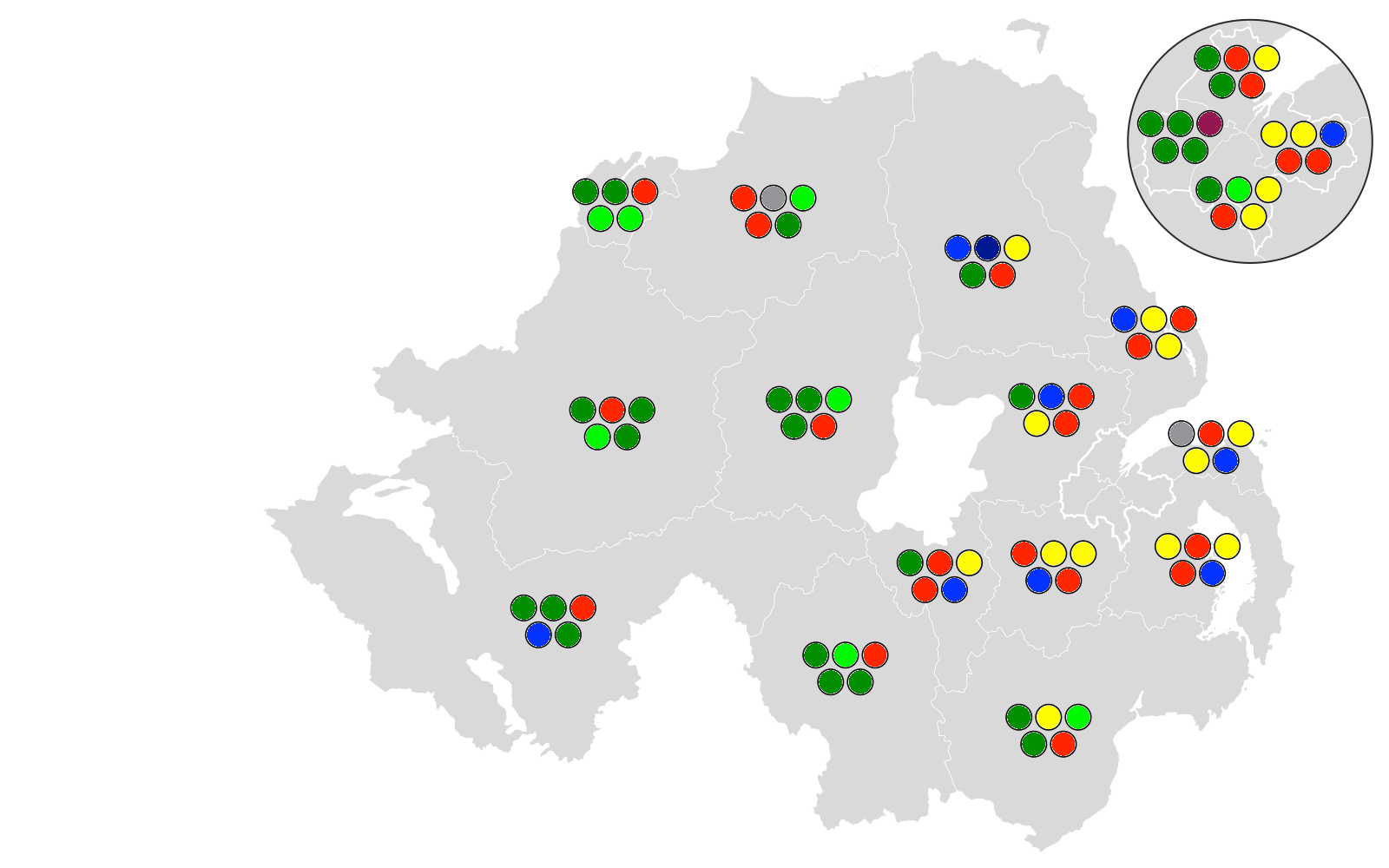
Northern Ireland uses eighteen constituencies which each elect five MLAs, for a total of ninety. The result of the last Assembly election in 2022 was:
Sinn Féin: 27
DUP: 25
Alliance: 17
UUP: 9
SDLP: 8
Independent: 2
TUV: 1
People Before Profit: 1
Until 2017, each constituency elected six MLAs, not five. If we still elected six MLAs per constituency, my estimation of the 2022 result, with one extra seat available per constituency, is:
Sinn Féin: 29
DUP: 29
Alliance: 18
SDLP: 12
UUP: 10
TUV: 5
Independent: 2
Green: 2
People Before Profit: 1
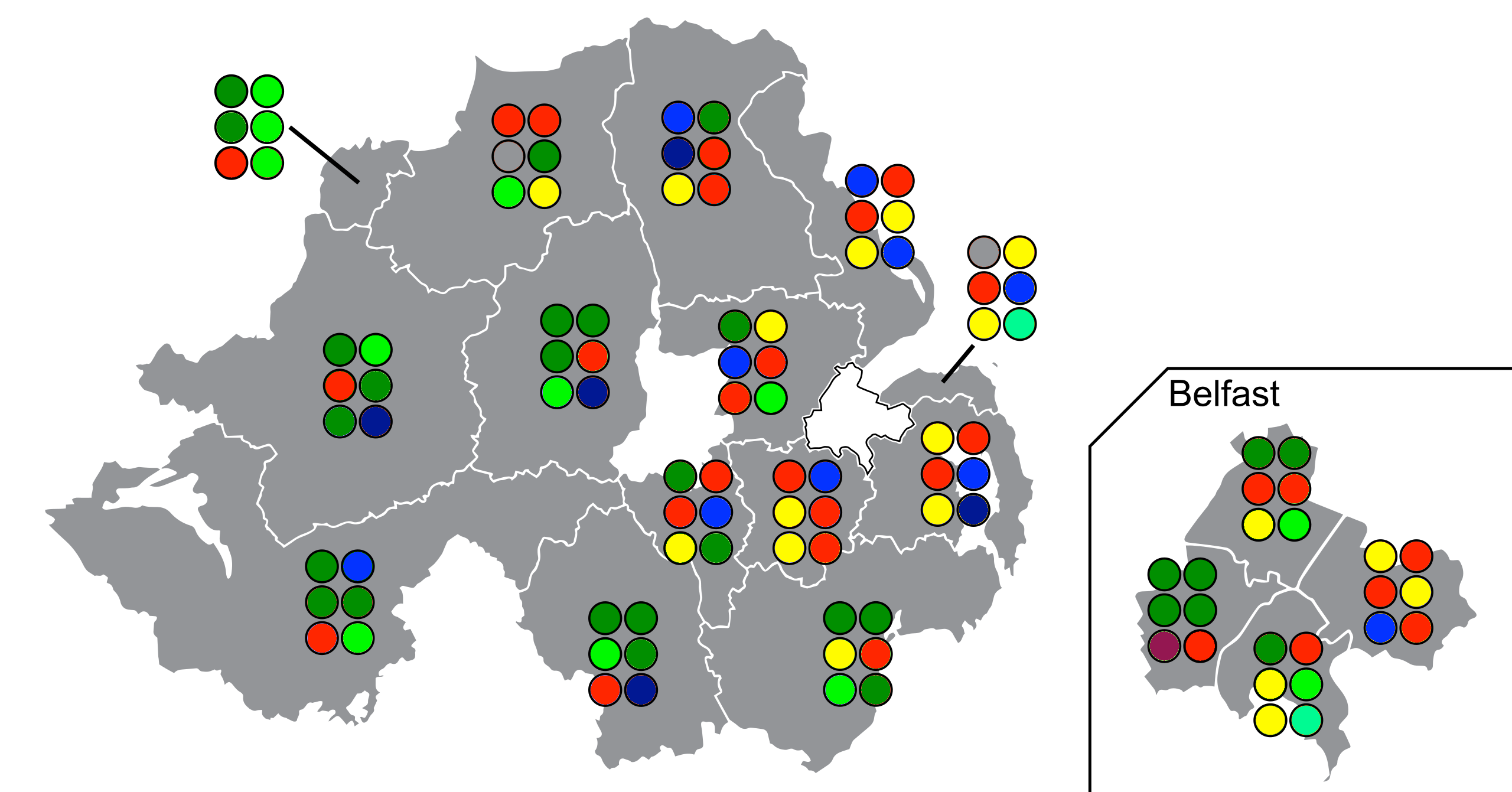
Some interesting changes occur if you add an extra seat to each constituency. Sinn Féin and the DUP are evenly matched at 29 seats each (in this scenario Sinn Féin would appoint the First Minister and the DUP the deputy First Minister, because Sinn Féin received more votes overall). The SDLP would receive more seats than the UUP on less votes, this happened before in 2017, where the SDLP also won 12 seats and the UUP 10. The TUV would gain four seats, mostly in majority nationalist constituencies like Mid Ulster, West Tyrone and Newry and Armagh. And the Green Party would not have lost their two seats, as they did in 2022.
First Past the Post
UK general elections, and most elections across England, are conducted through First Past the Post (FPTP). Under FPTP, each constituency elects one representative, whoever gets the most votes. Unlike STV, which ensures diverse representation and encourages moderation through allowing people to express a range of preferences, FPTP allows one or two parties to win a huge result on a very small percentage of the vote, while locking out parties who do well across the country but are not geographically concentrated. Look at what happened in the 2024 general election, Labour won two-thirds of seats on one-third of the vote.
If the Northern Ireland Assembly used FPTP, it would include many more constituencies which would each elect one MLA. In order to achieve this, I have used the existing district electoral areas (DEAs) that we use to elect councillors, of which there are eighty. Instead of electing five to seven councillors through STV, as they do in council elections, I have applied these eighty DEAs as single seat constituencies to elect one MLA through FPTP. The below result is based on the 2023 local election result, with results amended slightly to align more with the 2022 Assembly election. The result would be:
Sinn Féin: 41
DUP: 27
Alliance: 9
UUP: 2
TUV: 1
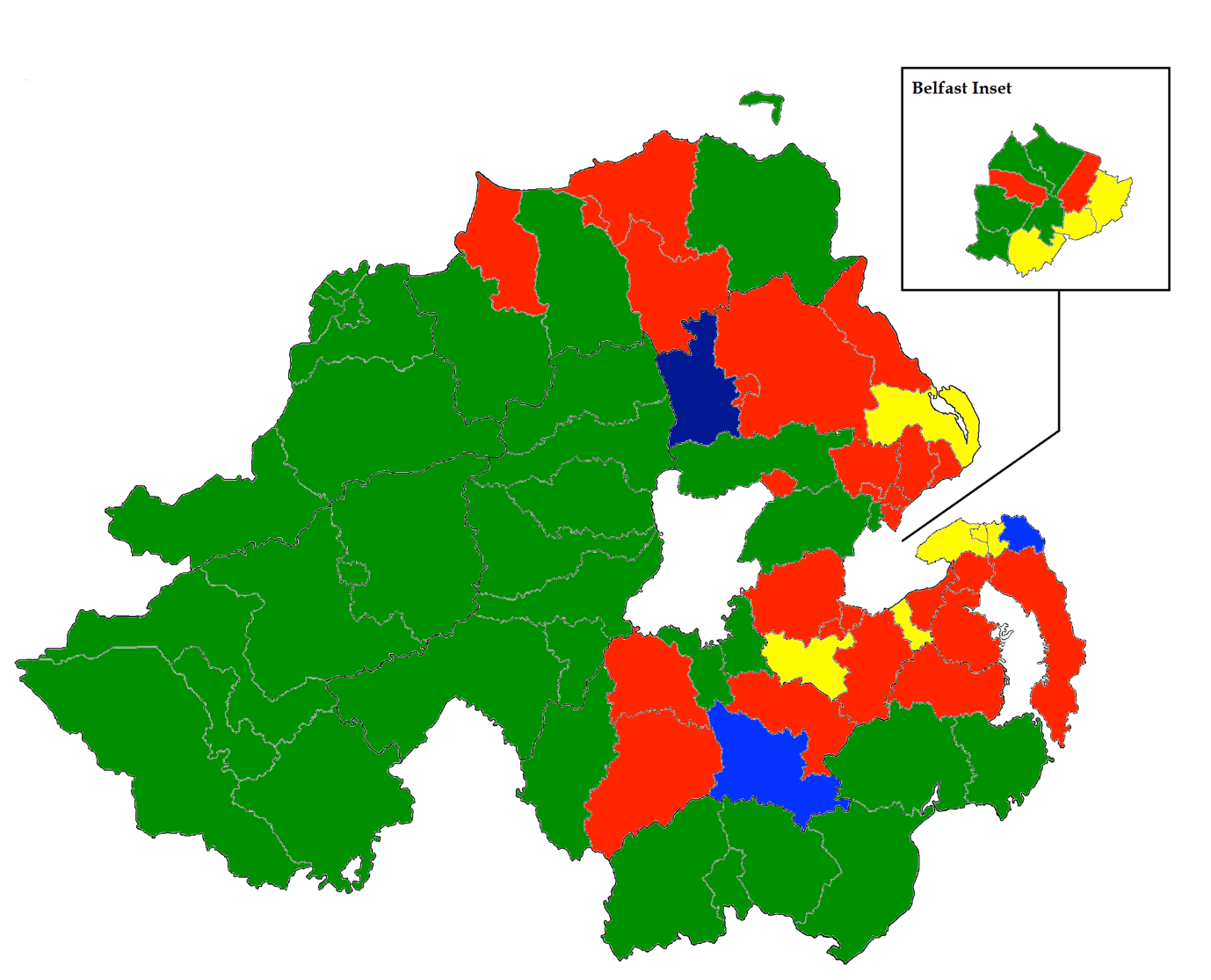
Under FPTP, Sinn Féin would win a majority of seats, and the SDLP none. The SDLP would come a very close second in several seats in Derry and South Down, but in FPTP only first place matters. Within unionism the UUP would be similarly squeezed by the DUP but they would still win two seats, and the TUV one. Alliance would do quite well given they would have historically been punished by FPTP, as has been the case in general elections until fairly recently.
Alternative Vote
In 2011 a referendum was proposed to replace FPTP with the Alternative Vote (AV) in UK general elections, which was sadly rejected by the electorate. AV is a preferential system which acts as a half-way point between FPTP and STV, each constituency still elects one member, but voters rank candidates numerically, so that the winner has to reach 50%+ of the vote. This still benefits the larger parties like FPTP, but it at least removes the wasted votes element from FPTP and requires candidates to seek out a broad range of support to win.
So let’s look at what would happen if the 2022 Assembly election was conducted using AV. I have used the 80 DEAs as with FPTP, but looked at the result of the other parties and how they most likely would have transferred. In Northern Ireland, this generally means unionists would transfer to each other and same with nationalists, but also centrist parties like Alliance may benefit. Here would be the result under AV:
Sinn Féin: 36
DUP: 29
Alliance: 7
UUP: 4
SDLP: 3
TUV: 1
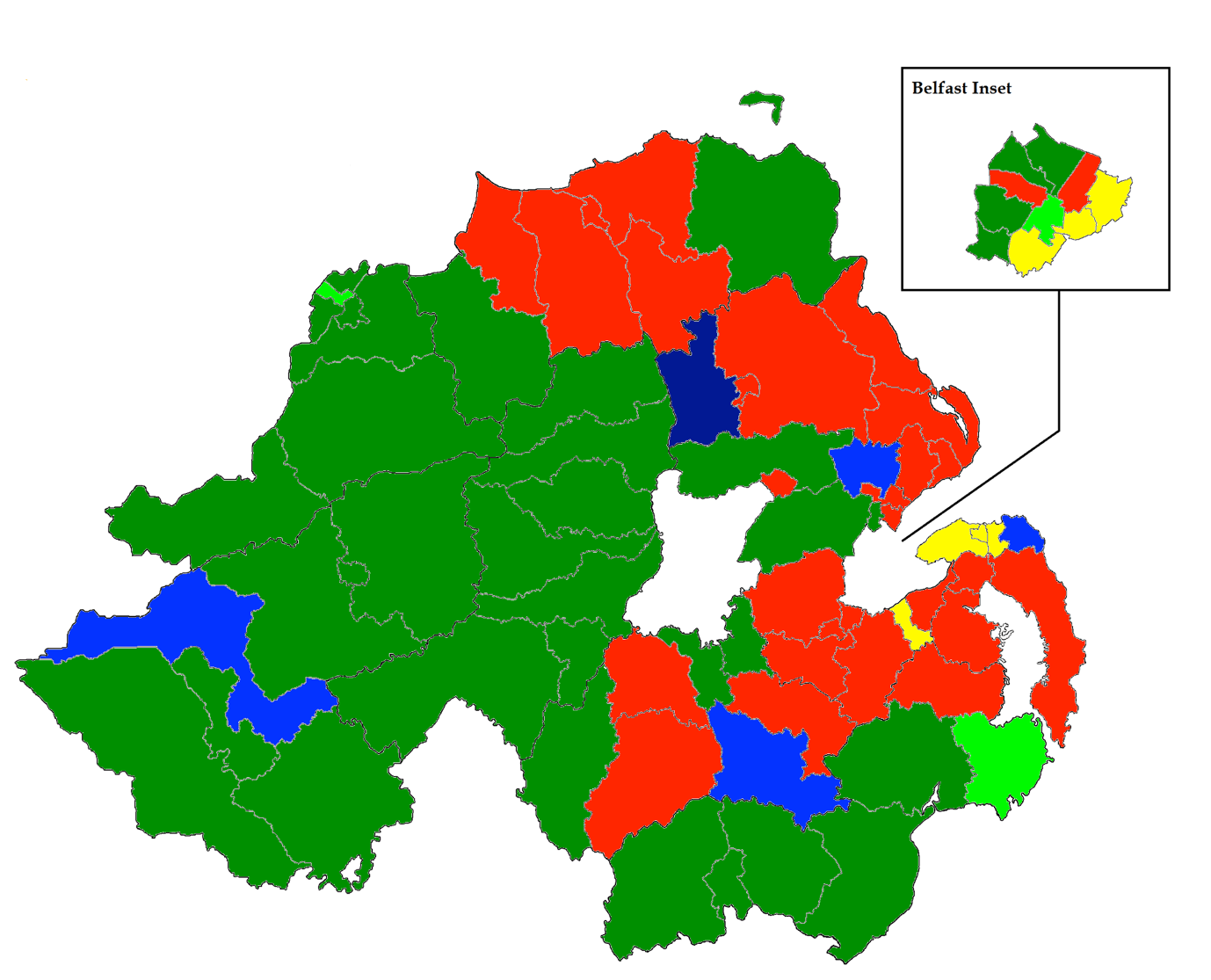
Compared to FPTP, the UUP and SDLP would do slightly better, because in a few constituencies each would benefit from Alliance transfers to defeat the main rival in their community, the DUP and Sinn Féin respectively. The DUP would do slightly better because in some areas Alliance would have won under FPTP due to a divided unionist vote, whereas under AV UUP and TUV transfers would save the DUP. This is interesting because it shows how AV would actually disadvantage Alliance, since in most cases Alliance has come first in elections it is in majority unionist constituencies, such as Lagan Valley in 2024.
Additional Member System
Next is the Additional Member System (AMS), the system used to elect the Scottish Parliament. AMS is a form of proportional representation, in which people receive two votes. The first vote is for a single constituency representative as in FPTP. The second vote is for a regional list. The regional representatives cover a larger area than constituency representatives, and these are calculated using the d’Hondt formula (more on this below). The list seats are calculated in a way that if a party has won seats at the constituency level, this is accounted for by giving more weight to parties which do not have constituency seats. This therefore ensures greater proportionality and representation of smaller parties. In recent Scottish elections, the SNP has won the vast majority of constituency seats, but they struggle to win an overall majority because the list seats therefore go to the other parties to balance their failure to win constituency seats.
In order to calculate this for the 2022 Assembly election in Northern Ireland, I have taken the existing eighty DEAs I have used for the FPTP elections, and created eleven regions to coincide with the eleven councils. Each would elect two less seats than the number of DEAs they have, e.g. Belfast has ten DEAs so it gets eight list seats, and the other regions have seven DEAs so they get five list seats. This would lead to 138 seats, 80 constituency and 58 list. As in Scotland, the constituency seats won are added to the calculations, for example Sinn Féin would win every seat in Derry and Strabane, Fermanagh and Omagh and Mid Ulster, so they would therefore not win any list seats because their constituency seats would be weighed against them here.
The result by AMS would be:
Sinn Féin: 41 constituency + 7 list = 48
DUP: 27 constituency + 8 list = 35
Alliance: 9 constituency + 9 list = 18
UUP: 2 constituency + 15 list = 17
SDLP: 0 constituency + 10 list = 10
TUV: 1 constituency + 7 list = 8
Green: 0 constituency + 2 list = 2
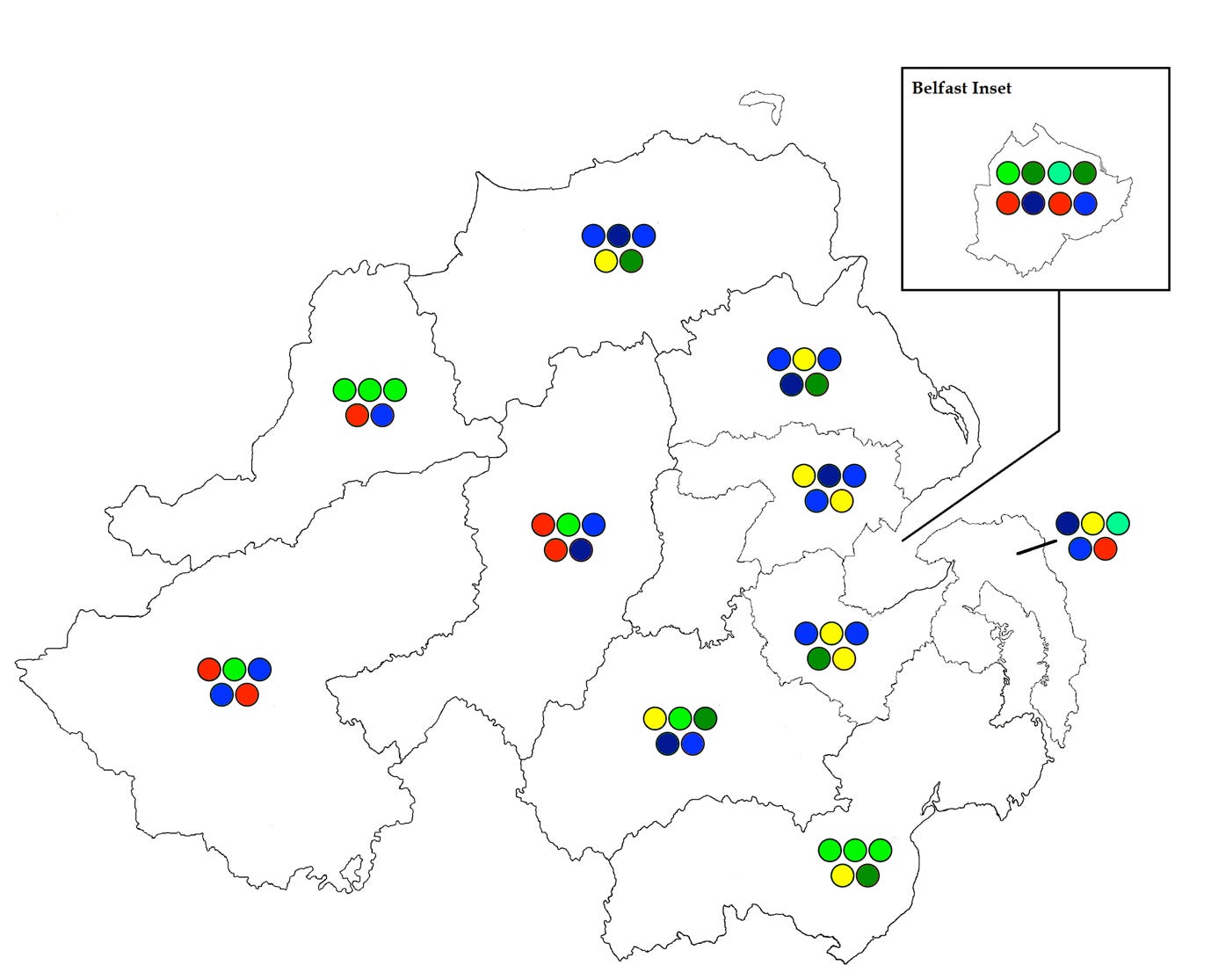
The result under AMS would lead to a fairly proportional result overall, particularly benefitting the smaller parties such as the TUV who struggled under STV due to unfavourable transfers. The UUP and SDLP would also do well having been squeezed under FPTP. The Green Party would also have won two seats under AMS, so they would have representation in the Assembly unlike STV, FPTP and AV. But People Before Profit would be absent, having narrowly missed out on seats in Belfast and Derry and Strabane. AMS also disproportionately impacts independents, so popular independents like Claire Sugden would have a more challenging time compared to STV.
D’Hondt
Last but not least is d’Hondt. D’Hondt is a more purely proportional system which was used in Wales for the first time last week. D’Hondt is also used in Northern Ireland, after the Assembly election, in order to allocate Ministers to parties based on their seat numbers. Simply explained, d’Hondt is designed to ensure that votes in each constituency roughly balance seats won. The first seat is allocated to the largest party, then the largest party’s vote is divided by two for the second seat, if that party wins a second seat their vote is divided by three, etc. This process continues until every seat is filled. You don’t vote for individual candidates, instead the parties produce a list and you vote for a party, the candidates will be ranked so it is clear who would be elected first, second, third etc.
Applying d’Hondt to the 2022 Assembly election is very easy, compared to the others we have looked at. I have looked at the overall party votes in each constituency, and ran the d’Hondt process to fill all five seats. The result of that is as follows:
Sinn Féin: 35
DUP: 24
Alliance: 12
UUP: 10
SDLP: 5
TUV: 2
Independent: 2
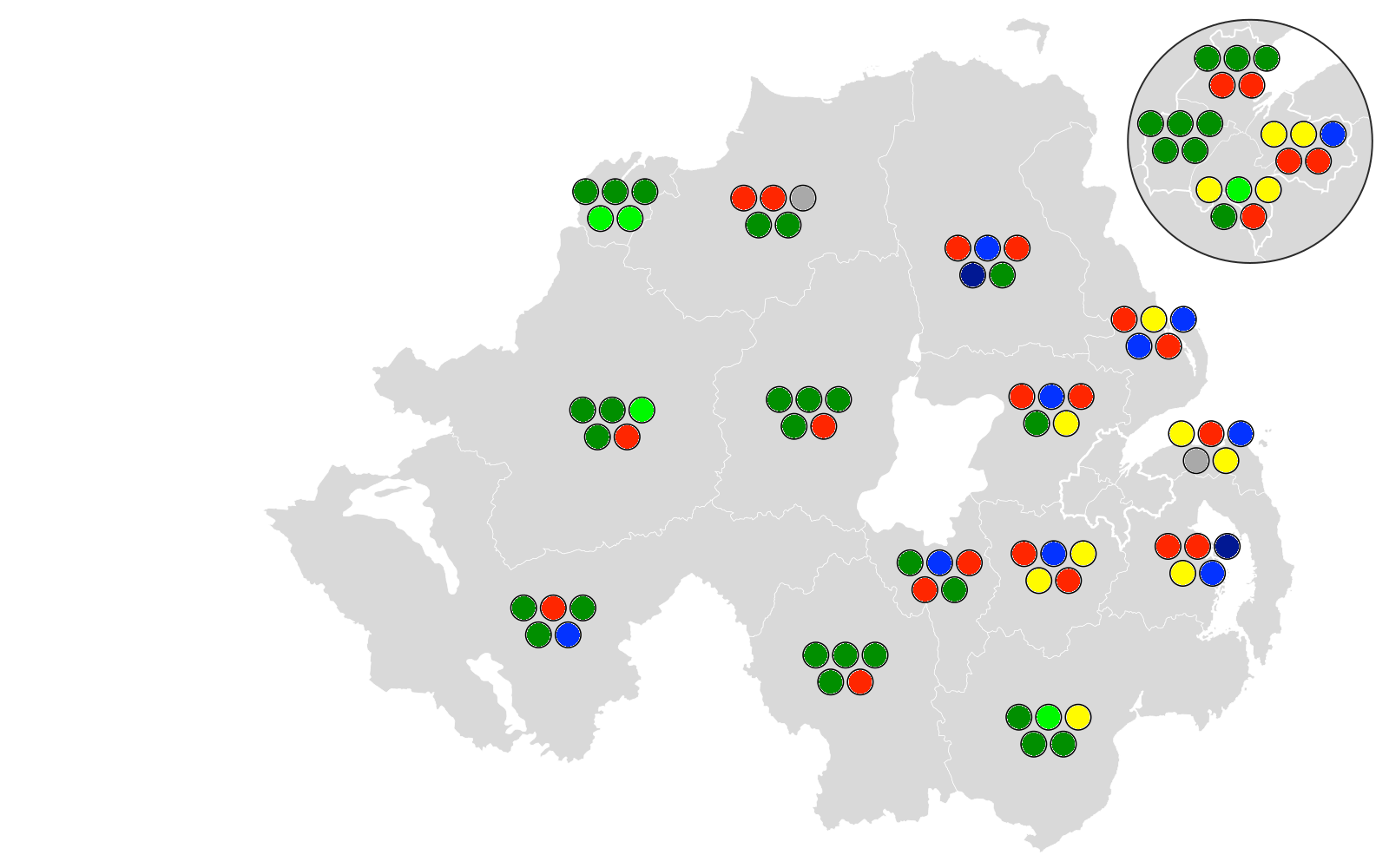
You can see from the above map just how much d’Hondt benefits the largest parties. Sinn Féin in particular would have some exceptional results, such as winning all five seats in West Belfast, and four out of five seats in Mid Ulster and West Tyrone. Alliance would be squeezed slightly, since several of their 17 seats won under STV were heavily dependent on favourable transfers. The same goes for the SDLP, who would lose several seats due to being unable to avail of Alliance transfers as in the real election. The DUP result is almost identical to the real election, except they would win two seats in North Antrim instead of one, and not win a seat in Foyle and South Down, no unionist would win in those two constituencies. Interestingly, both independents, Alex Easton (North Down) and Claire Sugden (East Londonderry), would win, but Sugden would gain the final seat instead of the DUP’s third candidate by just nine votes!
In Wales each constituency elected six members, so what if the Assembly elected six MLAs per constituency through d’Hondt? The result would be:
Sinn Féin: 41
DUP: 27
Alliance: 17
UUP: 10
SDLP: 7
TUV: 3
Independent: 3
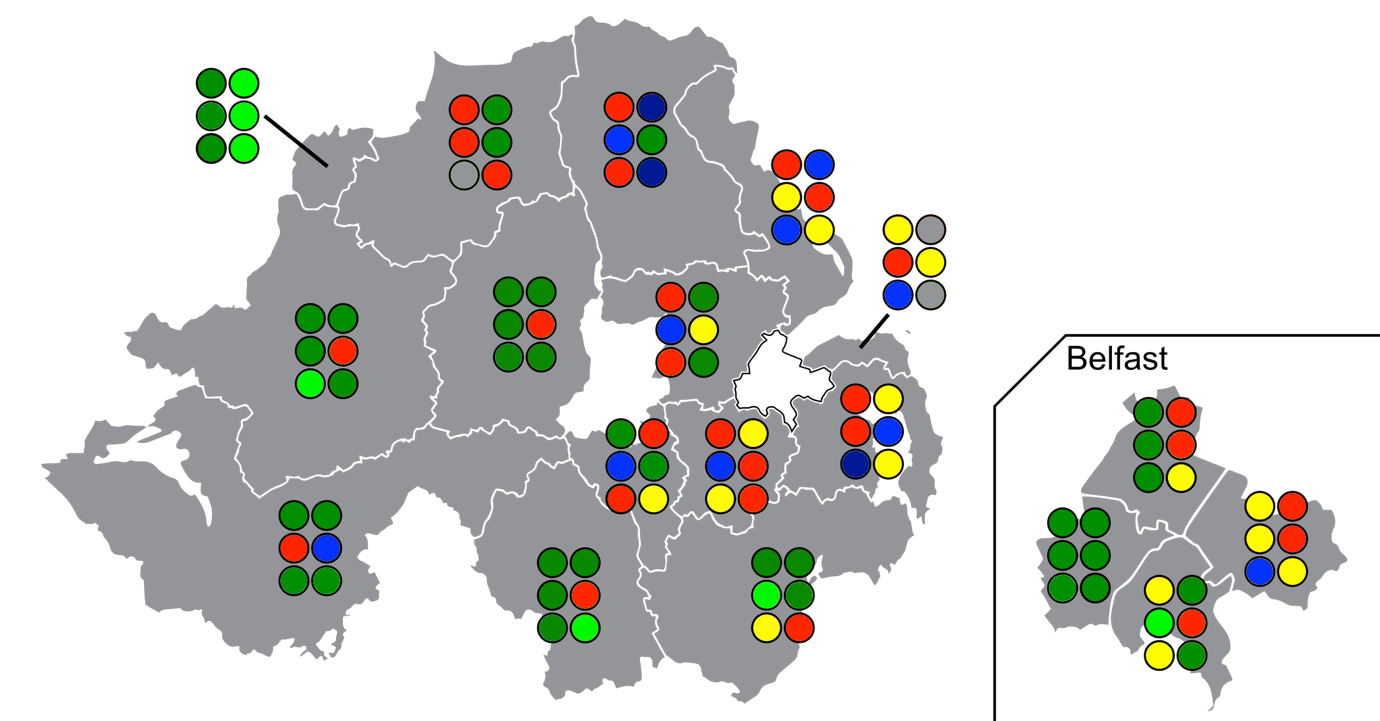
The addition of a sixth seat for each constituency gives every party a slight boost apart from the UUP. Sinn Féin’s dominance of West Belfast (six out of six seats) and Mid Ulster (five out of six seats) remains evident, as are the strong DUP results in East Londonderry and Lagan Valley. Alliance winning three seats instead of the DUP in East Belfast, by just 89 votes, would also be significant.
So these are just a few key electoral systems, and how introducing each to Northern Ireland Assembly elections might change political dynamics. Each has their pros and cons (except FPTP which are only cons), but my preference is for STV, I recently completed a PhD based on that exact argument. But there really isn’t a desire to change the electoral system, so we can all look forward to two exciting STV elections in just under a year.